Why I don’t publish a price list
People often ask me for a number before we have spoken about the project. I understand why, but a single price would mislead you. Two websites with five pages each can be completely different jobs: one is a simple showcase, the other has a booking flow, three languages and a connection to a sales tool. That is why I scope every project individually and send a written proposal once I understand what you need.
What I can do here is explain what actually moves the cost up or down, so you can compare quotes on substance and plan a realistic budget. Think of it as a map of the decisions that shape a project, from the number of pages to what happens after launch.
Scope and number of pages
The first driver is scope: what the website must do, and how many distinct page types it needs. A page type is a layout with its own logic, such as a home page, a service page, a project detail page or a contact page. Ten pages built from two templates cost less to produce than six pages that are all different.
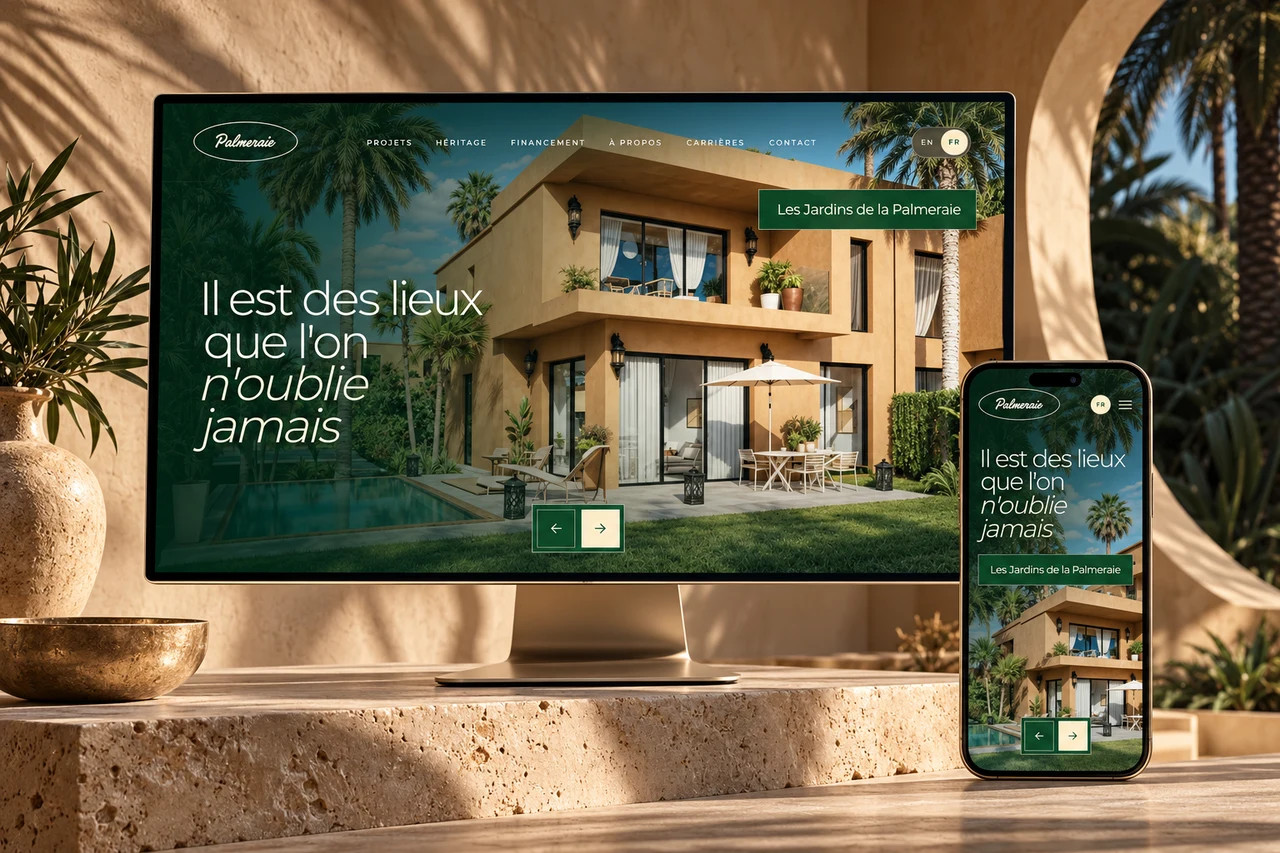
Functional depth matters even more than page count. A filterable catalogue, a property search, a quote calculator or a client area each add design, development and testing time. When I worked on Palmeraie, the financing tools and lead workflows were a bigger part of the effort than the number of pages.
- Number of unique page layouts
- Interactive features: search, filters, calculators, forms
- User accounts or private areas
- Admin needs: who edits what, and how often
Custom design or a template
A template gives you a ready-made layout that you adapt with your logo, colours and text. It is faster and cheaper to start, and it can be a sensible choice for a first website or a tight timeline. The trade-off is that you look like many other sites and you inherit the template’s limits and code quality.
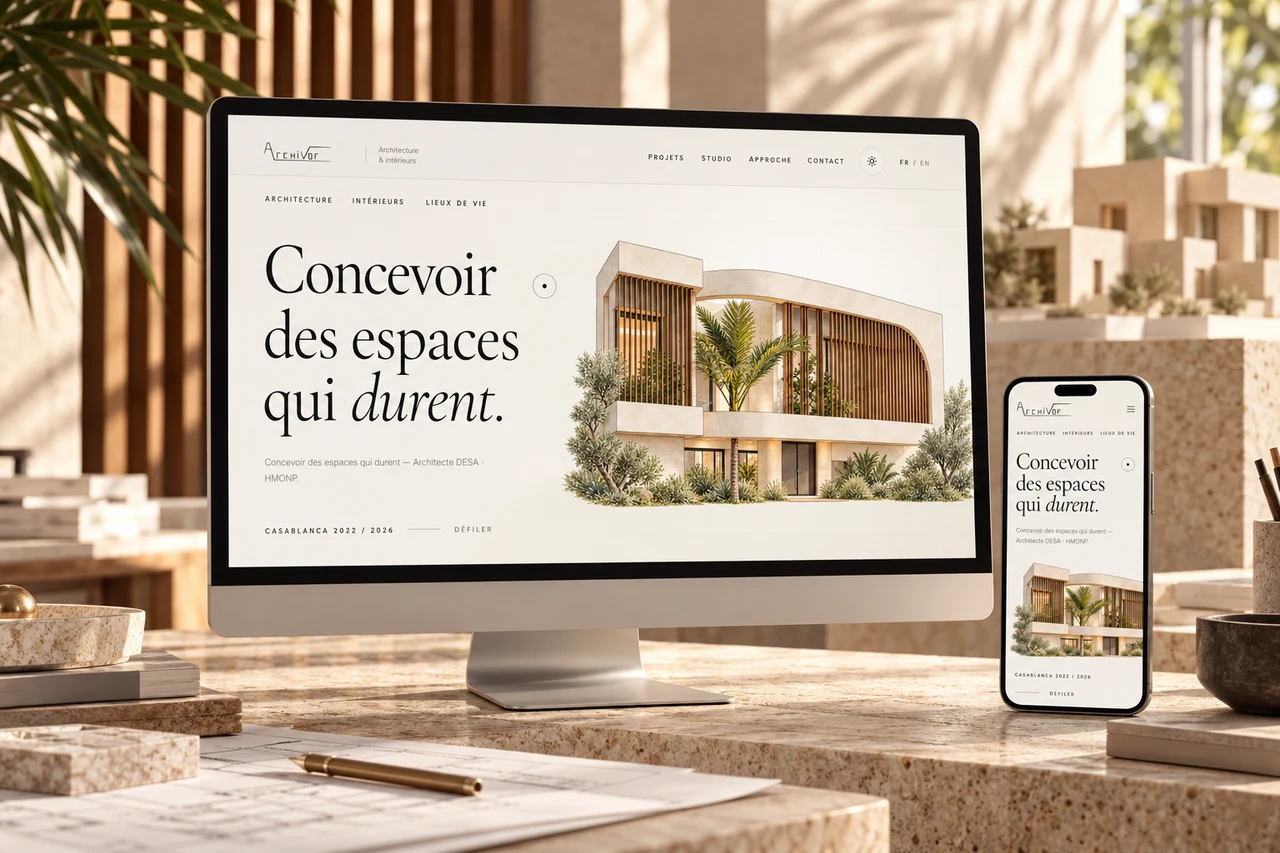
Custom design starts from your brand, your audience and your goals. It takes more time because it involves research, wireframes, visual design and refinement, but the result fits your business and is usually easier to evolve. For a brand like Archivor, where the portfolio is the product, a custom design was the only way to let the work speak properly.
Multilingual and Arabic RTL
In Morocco, many businesses need French and Arabic, and often English for international clients. Each language adds translation, proofreading, separate SEO metadata and testing. Arabic adds a specific layer: the whole layout must read right to left, with mirrored navigation, adapted typography and careful handling of mixed Arabic and Latin text.
Done properly, RTL is not a quick switch. It affects components, icons, forms and spacing, and it has to be tested on real devices in both directions. Ask any provider how they handle it, and ask to see an Arabic version of a site they have built.
Integrations, content and SEO
Integrations connect your website to other tools: online payment, a CRM, an email marketing platform, a booking system, WhatsApp, maps or analytics. Each one needs configuration, testing and sometimes custom code, and some come with their own subscription fees from the third-party provider.
Content is the most underestimated cost. Someone has to write the text, produce or source photos, and prepare product or project data. If you provide everything ready, the project moves faster. If you need copywriting, photography or translation, budget for it.
Technical SEO, such as clean structure, fast loading, metadata and structured data, should be part of a good build, because fixing it later costs more. Ongoing SEO, like content and link building, is a separate, continuous effort that depends on your market. No honest provider can guarantee a ranking.
- Payments: card gateway, cash on delivery, bank transfer
- CRM or lead management
- Booking or reservation tools
- Analytics and consent setup
- Copywriting, translation and photography
Hosting, maintenance and the total cost of ownership
The launch is not the end of the bill. A website needs a domain name, hosting, an SSL certificate, backups, security and software updates. A WordPress site in particular needs regular plugin and core updates. A custom application may need monitoring and server maintenance.
When you compare offers, look at the cost over two or three years, not only at the launch price. Ask what is included after delivery, how quickly issues are handled, and what happens if you want to change provider. You should own your domain, your content and access to your hosting.
How to scope a realistic budget
The best way to get an accurate proposal is to prepare a short brief. It does not need to be technical. It needs to explain your business, your goals and what you expect the website to do. With that, a developer can suggest a scope that fits your budget, and phase the project if needed.
Phasing is often the smartest approach: launch a solid first version with the essentials, measure how people use it, then add features based on real needs rather than guesses. It keeps the initial budget under control and avoids paying for features nobody uses.
- Your goal: leads, sales, bookings, credibility
- Your audience and the languages they use
- The pages and features you consider essential
- Examples of websites you like, and why
- Who provides content, and in what state
- Your timeline and any fixed launch date
Red flags in very cheap offers
A low price is not a problem in itself. The problem is a low price that hides missing work. Very cheap offers often rely on a pirated or heavily reused theme, skip mobile testing, ignore performance and SEO basics, or register the domain in the provider’s name. Some leave you without access to your own site.
Before you sign, ask exactly what is included, who owns what, and what support looks like after launch. Ask for it in writing, even if the project is small. A clear, written scope protects both sides and makes any later discussion about extras much simpler.
- No written scope or vague deliverables
- Domain or hosting registered in the provider’s name
- No admin access handed over to you
- No mention of mobile, speed or security
- Promises of guaranteed first-page rankings
- No portfolio with live, working websites
FAQ
Why won’t you give me a price straight away?+
Because two projects that sound similar can involve very different work. I prefer to understand your goals, content and features first, then send a written proposal with a clear scope, so the number you see actually matches what will be delivered.
Is a template always a bad idea?+
No. A well-chosen, properly licensed template can be a reasonable start for a simple site or a tight deadline. The key is knowing its limits, keeping the code clean, and making sure it is fast, secure and works well on mobile.
Does adding Arabic really change the budget?+
Yes. Beyond translation, Arabic requires a right-to-left layout, adapted typography, mirrored components and separate testing and SEO metadata. It is very achievable, but it is real work and should appear clearly in any proposal.
What ongoing costs should I expect after launch?+
Plan for the domain name, hosting, SSL, backups, security and software updates, plus any third-party subscriptions such as payment or CRM tools. Content updates and ongoing SEO are additional, depending on how actively you want to grow the site.