Start with how your customers will pay
Payment is the first decision, because it shapes your platform, your cash flow and your operations. In Morocco, online card payments are generally processed through gateways connected to the CMI (Centre Monétique Interbancaire), usually set up via your bank. The process involves a merchant agreement and technical integration, so start early.
Cash on delivery remains a very common way to pay for online orders in Morocco, and many customers expect it. It reassures first-time buyers, but it also means handling cash collection and refused deliveries. Bank transfer can work well for higher-value orders or business customers.
- Card payments through a CMI-connected gateway
- Cash on delivery, with a clear confirmation process
- Bank transfer for larger or B2B orders
- Clear rules for refunds and failed deliveries
Plan delivery and returns before launch
Delivery is part of your product. Compare local courier and logistics partners on coverage across cities, delivery times, cash-on-delivery collection, how quickly collected cash is paid back, tracking, and how they handle returns. Ask for their tools: some offer dashboards or APIs that can connect to your store.
Write a delivery and returns policy in plain language before you open: delivery zones, delays, fees, what happens if the customer is absent, and how exchanges work. Confirming orders by phone or WhatsApp before shipping is a common practice that can reduce failed cash-on-delivery deliveries.
- Coverage, delays and fees by city or region
- Cash collection and payout schedule
- Tracking for you and for the customer
- Returns and exchange process
- Order confirmation before dispatch
Choose a platform that fits your catalogue
Your platform should follow your catalogue and operations, not the other way round. Hosted e-commerce platforms are quick to set up and handle hosting for you. WooCommerce adds a store to WordPress and offers a lot of flexibility. A custom build makes sense when you have specific workflows, such as made-to-order products, unique items or connections to stock and accounting tools.
Before deciding, check which payment gateways and delivery services integrate with the platform in Morocco, how product data is managed, and what monthly or transaction fees apply. For a store selling one-of-a-kind items, like a vintage shop, stock must update instantly so the same piece is never sold twice.
- Payment and delivery integrations available locally
- Ease of adding and editing products
- Multilingual and Arabic RTL support
- Fees: subscriptions, apps, transactions
- Ability to export your data
Design mobile-first
Many of your visitors will arrive from social media on a phone, often on a mobile connection. Design for that screen first: readable text, large tap targets, fast-loading images, a visible cart and a short checkout with only the fields you really need.
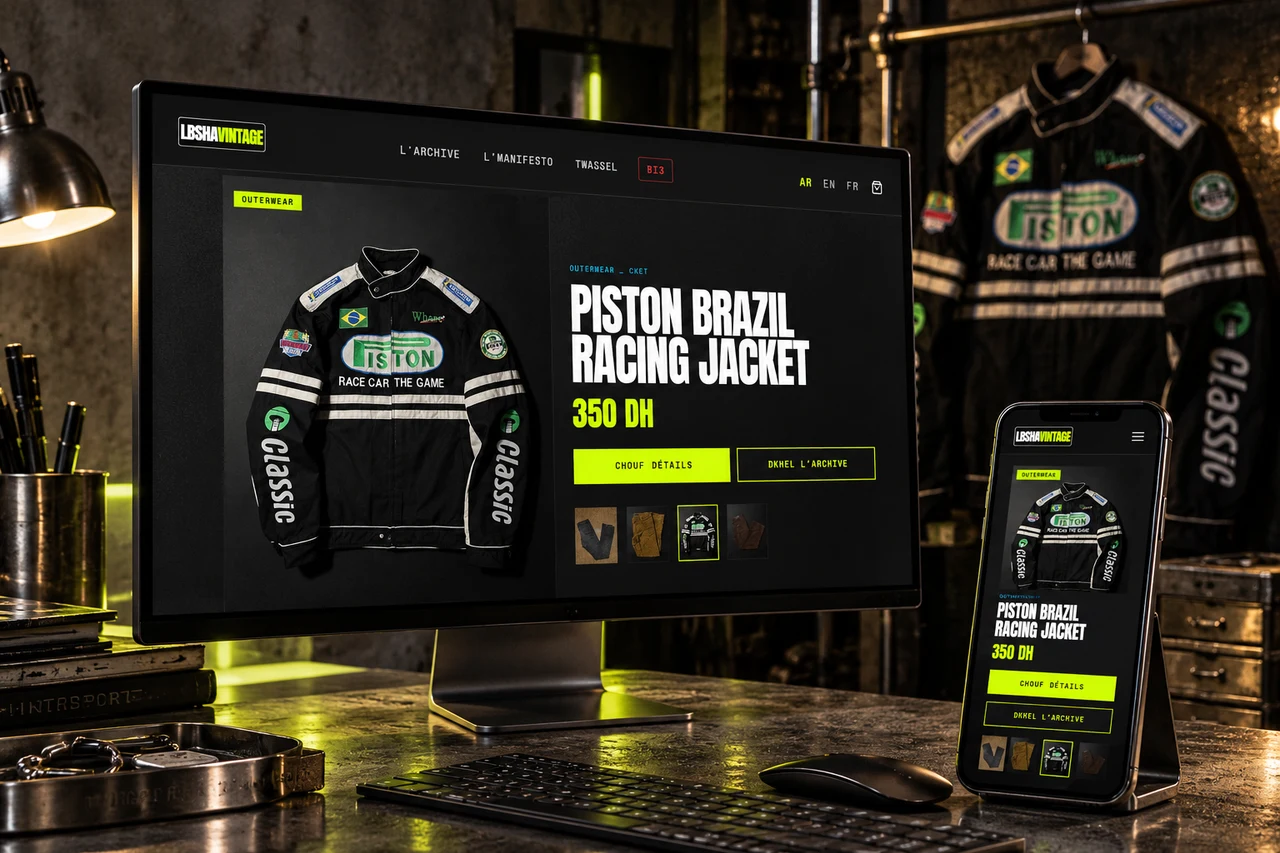
On Lbsha Vintage, a vintage fashion storefront, the mobile experience was the starting point rather than an afterthought. Product browsing, sizing details and the path to order were designed for one-handed use, then expanded for larger screens, so the desktop version gained space without losing simplicity.
Product pages that answer every question
A product page replaces the conversation a customer would have in a shop. It should answer, without scrolling forever, the questions that block a purchase: what exactly is it, how much does it cost delivered, when will it arrive, and what if it does not fit.
Good photos matter more than decoration. Show the product from several angles, in context and at real scale, with consistent lighting across the catalogue. Write descriptions in the languages your customers use, typically French and Arabic, and keep prices, stock and variants accurate at all times.
- Clear photos from several angles
- Price, delivery cost and delay visible early
- Sizes, materials, dimensions and care
- Stock and variant availability
- Return and exchange summary
- A direct way to ask a question
Build trust and use WhatsApp wisely
New shoppers need reasons to trust an unknown store. Show who you are, a real address or city, a phone number, clear policies and secure payment indicators. Real customer reviews help, but only if they are genuine; never invent them.
WhatsApp is widely used in Morocco and can be a strong support channel. A visible WhatsApp button lets customers ask about sizes, availability or delivery before ordering. Define response times and who answers, so the channel stays helpful rather than overwhelming.
Legal pages and personal data
Your store will collect personal data: names, phone numbers, addresses and sometimes payment information. In Morocco, law 09-08 governs the protection of individuals with regard to the processing of personal data, and the CNDP (Commission Nationale de contrôle de la protection des Données à caractère Personnel) is the authority responsible for overseeing it.
I am not a lawyer, and this is not legal advice. Before launch, consult a qualified professional about your obligations, including any declarations to the CNDP, and prepare clear legal pages. As a developer, my role is to make those pages easy to find and to collect only the data the store really needs.
- Legal notice with company details
- Terms and conditions of sale
- Privacy policy explaining data use
- Delivery, returns and refund policy
- Cookie and consent information where needed
Measure from day one
Set up analytics before launch, not after. At minimum, track visits, traffic sources, product views, add-to-cart, checkout starts and completed orders. This tells you where people drop off and which channels actually bring buyers, instead of relying on likes, followers or other impressions that do not pay the bills.
Respect consent rules when you add tracking tools and advertising pixels, and review the numbers regularly. Small improvements to product pages, delivery information or checkout are often worth more than more traffic. A short weekly review is usually enough to spot what needs attention.
- Analytics and e-commerce events configured
- Conversion tracking for ads, with consent
- Search Console for organic visibility
- A simple weekly review of key numbers
FAQ
Do I need card payments to launch an online store in Morocco?+
Not necessarily on day one. Many stores start with cash on delivery and bank transfer, then add card payments through a CMI-connected gateway. Offering card payment can reassure some customers, so it is worth planning even if it comes later.
Which platform should I use for my online store?+
It depends on your catalogue, budget and growth plans. Hosted platforms and WooCommerce can work well for standard stores, while a custom build fits specific workflows or integrations. Check payment and delivery integrations available in Morocco before you decide.
Do I need to declare my store to the CNDP?+
Collecting customer data can create obligations under law 09-08, which the CNDP oversees. The exact requirements depend on your situation, so consult a qualified legal professional before launch rather than relying on general articles.
How can I reduce refused cash-on-delivery orders?+
Show the total price including delivery clearly, confirm orders by phone or WhatsApp before shipping, give realistic delivery times, and keep customers informed with tracking. Clear product information also reduces surprises at the door.